Showing posts with label Comix. Show all posts

Thursday, July 3, 2014

Thoughts on a few Comix and the Kindle Panel View

Most of the comics I’ve read over the last six months were on the Kindle reader.  The “Kindle Panel View” presents first the full page of the comic, and then you scroll through each of the individual panels on that page. It’s fascinating, and has both benefits and negatives. On one hand, it’s difficult to see the complete picture that all of the integrated panels construct – which can be a problem when reading Alan Moore comics, or comics where the layout contains unusual panels. On the other hand, zooming in on some of the smaller panels provides an intense focus on the brushwork details of the (for example, some of the amazing inking in the Swamp Thing's Floronic Man).  Overall, I still find myself wanting to read comix in their original format, but I imagine if I had a larger color screen I’d feel differently.


So what have I read? Let’s start off with the most recent: Saga of the Swamp Thing Book 1, which contains issues #20-27 of the series run, starting from when the imitable Alan Moore took over writing the story of this strange plant man. The first issue is a creepy but pretty straightforward closing of plot lines from the previous writer blatantly called “Loose Ends.” But with the next issue Moore started to put his stamp on the story, taking us into a trippy world where the Swamp Thing is more than just a cheesy monster but something of great power and beauty. Moore takes us on a journey, showing us how Swamp Thing realizes that the bio-restorative formula accident (a formula "that can make forests out of deserts") that that everyone thought  turned scientist Alec Holland into Swamp Thing in reality simply put Holland’s consciousness in some elemental plant-thing. (It’s much more interesting than I’m making it sound.) Despite the stories’ cosmic and epic nature, Moore's writing remains very human – giving us a depth of feeling and motivation behind most of the major characters in a way that most major label comics simply don’t have. Does it all work? No – cameos by the Justice League are strained, and the later issues where Swamp Thing confronts the bizarrely-clad demon Etrigan aren't nearly as moving as the issues without the rest of the DC Universe. Still, Moore’s immaculate pacing and creepy sensibility shine through, supported by Stephen Bisette and John Totleben’s detailed and creepy drawing. Their art - a strange mixture of awkwardness and twisted beauty – consists of lots of crosshatching flowing together in fascinating ways. It’s not at it’s best when depicting action sequences, or traditional “men-in-tights” superheros, but then that’s okay, since at it’s core this is a horror comic par excellence.

(As a side note, since I was reading this on the kindle it was black and white. I've since taken a look at the colored version on the iPad and it was a MUCH lesser experience IMO - the garish colors overwhelmed and took away from the mood and the beauty of the art. Be warned.)

Now the term "horror" is overused these days – it’s more of a genre description than a description of a feeling. Take Junji Ito’s Uzumaki, for example. Uzumaki  (“spiral” in Japanese) tells the tale of Kurôzu-cho, a Japanese town that is haunted by the pattern of the spiral and is touted as “a masterpiece of horror magna”. It’s a fantastic comic, one that’s genuinely creepy, disgusting, and macabre. But the book as a whole I can’t promote as true horror because the stories don’t combine to tell a complete tale. In reality, after the first few issues honest characters would have run screaming from the town, or crumbled into insanity under the weight of what they saw and their inability to escape it. But this is due partly to the episodic nature of monthly comix: Ito sets up his theme and explores it in inventive and genuinely creepy ways. (The man’s ability to generate genuinely horrific and disturbing images is uncanny.) But like weekly tv shows, the characters needed to be reset before each episode, or change so incrementally that they’re essentially the same. It's only as the series starts to reach its conclusion in the last few issues that it starts to really tell a cohesive tale. In short, despite many excellent moments, it doesn't have the depth of character to inspire the same levels of horror as Moore. But some of those images will just not leave my mind.

I should say that it's unfair to compare any other comics to Moore’s work. His ideas that span multiple issues or volumes seems to rise up out of him fully formed. For instance, check out Watchmen, and how single graphic frames in one issue will have powerful implications many issues down the road. Anotehr great example are the incredible multi-page spreads in Promethia where the art promotes the theme of the story while also moving forward the plot. In short, Moore thinks thematically while retaining a command of the details - a hard skill in any field, but one that is in short supply in comix.

Unless you also read Carla Speed McNeil's Finder, that is. She's the first comix artist since Moore that has impressed me with her thematic reach while being so impressive at a detailed level. (and I'm talking really detailed: check out the depth of thought revealed in the footnotes of her Finder Library volumes and you get a real sense for the amount of time and effort she's spent building up her world.) I have Volumes 1 & 2 and while I can’t say that I understand everything about it, she’s is simply a fantastic storyteller: both engaging & entertaining. What I love are the sheer profusion of bizarre details in her "aboriginal science fiction" – most of the stories take place in a far future where everyone lives in domed cities with fascinating technology, not all of which works (some details of maintenance have been lost to time). The main plotline is ostensibly about Jaegar, an aboriginal of some kind who can both track anyone (the Finder of the title) and serves as a “sin eater” (Wikipedia describes it as being a “ritual scapegoat” which I really like).  However, my favorite plot is Dream Sequence, where Magri White, a person who grows an extremely popular virtual reality in his head around which a successful corporation grows – but when White starts to lose his grip on reality, the people hooked on the world in his head start suffering strange and dramatic fates. The skill by which she weaves the effects of the big story together with the struggle in White’s life – and how she visually depicts White’s loosening grip on reality – is very complelling, to the point where I’ve revisited the story multiple times since it was first published in the late 2000s.

So other than the occasional Hellboy, that’s all of the comix I’ve been reading these days. What else should I be checking out?

Thursday, January 2, 2014

First Lines of Alan Moore's "The Saga of the Swamp Thing"

"It's raining in Washington tonight. Plump, warm summer rain that covers the sidewalks with leopard spots. Downtown, elderly ladies carry their houseplants out to set them on the fire escapes, as if they were infirm relatives or boy kings."
- Alan Moore, The Saga of the Swamp Thing #21.

Big Alan Moore fan here, but for some reason i've never read his classic run on Swamp Thing. I rectified some of that by plowing through The Saga of the Swamp Thing Book 1 yesterday. Great stuff. I'll be posting my thoughts on it and some of the other graphic novels I read in late 2013 shortly.

Monday, August 12, 2013

Calvin and Hobbes Live

It's indisputable that Calvin and Hobbes is the best comic strip in existence. That fact is self-evident, but if for some strange reason you need proof, check out Progressive Boink's collection of 25 classic C&H strips.

Bill Watterson, we miss you.

Friday, May 10, 2013

Tab Dump (as Seen on TV!)

Check out these amazing pictures from A Brief History of Children’s Picture Books and the Art of Visual Storytelling - some amazing pictures here.

The Kinks are one of the best rock bands of all time, and were fueled by the tension between brothers Ray and Dave Davies. We've heard Ray's story, now we can see Dave's side in this documentary.

Is S&M anti-feminist? Um... no.

A good primer on reading Thomas Pynchon's Gravity's Rainbow

Dear SciFi writers, please stop being so pessimistic.

On the subject of Stephenson, here's a fun examination of how relevant his dreams of a data haven are today. BTW, if you haven't read Cryptonomicon, what are you waiting for?

A good video explaining why "global warming" is a misnomer and explaining why yes, climate change means that your average situation may get more extreme. "The wet get wetter and the dry get drier"

Everything you need to know about culture in 10 books

A great Interview with Kim Stanley Robinson at Capitola Book Café in 2012

In other KSR news, the quantum computers that he predicted in his books (specifically in 2312) is one step closer to reality. Money quote:
The D-Wave machine, which its makers say makes use of such unusual properties of quantum physics as a particle’s ability to move in one direction and its opposite at the same time. ... While quantum properties are among the most tested and proven domains of physics, the concepts behind them — for example, suggestions that we live in one of many universes, or that objects not in direct contact can affect each other — make such properties hard to accept.
Harnessing them for the sake of computation, suggested as a possibility more than two decades ago, has proved difficult.
The optimization problem is typically something like how a traveling salesman would plan a complicated trip most effectively. Ms. McGeoch tested three problems involving optimization. In two of them, the D-Wave computer was slightly faster. In the third, it was markedly faster.
Read the whole thing. It's just fascinating.

Along those lines, Quantum Foam is just a cool thing to ponder.

Comics:
My first introduction to Jack Gilbert's excellent poem "Failing and Flying"

Take the time to see the beauty in boredom.

A New Yorker report on the light pollution epidemic and an analysis of how Tucson, AZ of all places solves the problem:

Tucson’s code limits the brightness of exterior fixtures and requires most of them to be of a type usually known as “full cutoff” or “fully shielded,” meaning that they cast no light above the horizontal plane and employ a light source that cannot be seen by someone standing to the side. These are not necessarily more difficult or expensive to manufacture than traditional lights, and they typically cost less to operate. Calgary, Alberta, recently cut its electricity expenditures by more than two million dollars a year, by switching to full-cutoff, reduced-wattage street lights.
A fun, old-school Aphex Twin video interview from 1996

Thursday, February 7, 2013

"Mature" Comics

For some reason, the trend in comics appears to be towards presenting more "mature" content. My mature, read sex and blood. The most egregious example I've recently seen is Batman and Catwoman fucking, although Noah Berlatsky points out that the new Wonder Woman comics are cut out of the same cloth:
That blood is supposed to be the guarantor of sophistication and knowledge; it's the sign of adulthood and, not coincidentally, of masculinity. And yet, is Azzarello/Chiang [the current creative team] really more sophisticated than Marston/Peters [Wonder Woman's creators]? After all, a golden love gun isn't really any less ridiculous than a golden lasso of compulsion. And as far as that iconic measure of adulthood known as sex goes, Marston seems a lot more adventurous than his successor. The original Wonder Woman comics included page after page of bondage imagery, scads of cross-dressing villains, and really remarkably unrepressed lesbian eroticism. The best Azzarello/Chiang can do, in contrast, is to have their Amazons pose like Playboy models while Eros makes sophomoric cracks about the quest for seminal mortal vessels.
Azzarello's comics, then, are for older readers, and they fairly consciously embrace the blood-curdling masculinity that Marston decried. But that doesn't mean that blood-curdling masculinity is more adult than the alternative. It simply means that blood-curdling masculinity in this case—and not just in this case—justifies itself ideologically through appeals to maturity and realism. But making Wonder Woman more violent doesn't make her more mature or more real. It just makes her more conventional.
Good points. I'd expand this to include the loss of comics that you can read with your children without exposing them to sex, death, and bloody zombies. I'm continually looking for newer comics to show to my kids and none of the traditional series are IMO appropriate, leaving me with the option of going with back issues of older comics or series explicitly marketed to kids (Lego Star Wars, Super Hero squad, etc.). I fear that if/when the major superhero comics make this leap to "mature" content, they abandon the alluring gateway that introduced superheros to kids in the first place.

Wednesday, January 23, 2013

Wednesday, September 26, 2012

Bride of Tab Dump

Who has time to write up thoughtful reactions to all of the cool things out on the internet? Isn't it easier just to throw you some links and let you read what you want? Enjoy!
  • A collection of excellent old SciFi Illustrations by Shusei Nagoka. Although it's incongrous to see cool spaceship art side-by-side with cheezy 70s band cover art. 
  • Los Bros Hernandez are continually singing the praises of Bob Bolling's Little Archie comic books as the inspiration for their work on Love and Rockets - in particular the awesome "Lil Kids" segments. Big Blog Comics shows us an example of his work, and it's as fun as you expect.
  • Thinking of working in some fartlek work into my running, but haven't actually done so yet.
  • Cool footage from Pavel Klushantsev's The Road to the Stars film, an inspiration for 2001
  • Miles Davis: Genius, Hustler, and Superstar.
  • David Byrne recently published what sounds like a fascinating book: How Music Works. Brain Pickings has a synopsis, while Smithsonian published an excerpt that includes his interesting thoughts on silence:
    In 1969, Unesco passed a resolution outlining a human right that doesn’t get talked about much—the right to silence. I think they’re referring to what happens if a noisy factory gets built beside your house, or a shooting range, or if a disco opens downstairs. They don’t mean you can demand that a restaurant turn off the classic rock tunes it’s playing, or that you can muzzle the guy next to you on the train yelling into his cellphone. It’s a nice thought though—despite our innate dread of absolute silence, we should have the right to take an occasional aural break, to experience, however briefly, a moment or two of sonic fresh air. To have a meditative moment, a head-clearing space, is a nice idea for a human right.
    John Cage wrote a book called, somewhat ironically, Silence. Ironic because he was increasingly becoming notorious for noise and chaos in his compositions. He once claimed that silence doesn’t exist for us. In a quest to experience it, he went into an anechoic chamber, a room isolated from all outside sounds, with walls designed to inhibit the reflection of sounds. A dead space, acoustically. After a few moments he heard a thumping and whooshing, and was informed those sounds were his own heartbeat and the sound of his blood rushing through his veins and arteries. They were louder than he might have expected, but okay. After a while, he heard another sound, a high whine, and was informed that this was his nervous system. He realized then that for human beings there was no such thing as true silence, and this anecdote became a way of explaining that he decided that rather than fighting to shut out the sounds of the world, to compartmentalize music as something outside of the noisy, uncontrollable world of sounds, he’d let them in: “Let sounds be themselves rather than vehicles for manmade theories or expressions of human sentiments.” Conceptually at least, the entire world now became music.
  • What successful people do with the first hour of their work day
  • Warren Ellis awesome talk on on "How to see the Future" A must read, filled with interesting stories and facts. My favorite is this:
    The Olympus Mons mountain on Mars is so tall and yet so gently sloped that, were you suited and supplied correctly, ascending it would allow you to walk most of the way to space. Mars has a big, puffy atmosphere, taller than ours, but there’s barely anything to it at that level. 30 Pascals of pressure, which is what we get in an industrial vacuum furnace here on Earth. You may as well be in space. Imagine that. Imagine a world where you could quite literally walk to space.
    That’s actually got a bit more going for it, as an idea, than exotic red deserts and canals. Imagine living in a Martian culture for a moment, where this thing is a presence in the existence of an entire sentient species. A mountain that you cannot see the top of, because it’s a small world and the summit wraps behind the horizon. Imagine settlements creeping up the side of Olympus Mons. Imagine battles fought over sections of slope. Generations upon generations of explorers dying further and further up its height, technologies iterated and expended upon being able to walk to within leaping distance of orbital space. Manufactured normalcy would suggest that, if we were the Martians, we would find this completely dull within ten years and bitch about not being able to simply fart our way into space.

Friday, September 14, 2012

Graphic Novel of "A Wrinkle in Time"

Hope Larson has created a graphical version of Madeleine L'Engle's A Wrinkle in Time. It's a fantastic book, and the example pages not only look great but appear to be a very honest adaptation.

I recently re-read A Wrinkle in Time and came away very impressed yet again. Part of that is that I have such fond memories of the book from my youth, but most of it is just that it's very well written. 

Tuesday, June 12, 2012

Happy Ghost World Day!

12th of June, a gibbous moon
Was this the longest day?
I'll walk down to the bay
And jump off of the dock and watch
The summer waste away

Then, I'm bailing this town... or
Tearing it down... or
Probably more like
Hanging around
Hanging around
Just hanging around

- Aimee Mann, from "Ghost World", off the fantastic album Bachelor No. 2 or, the Last Remains of the Dodo. And yes, it was influenced by the equally awesome Ghost World comic by Daniel Clowes.

Thursday, May 17, 2012

Avengers Assemble!

I pulled in a few chips and stayed up too late, but my trip to the movies last night to see The Avengers was worth it. It's a fun movie that takes the original comics seriously but also includes a liberal dose of absurdest joy at the sheer spectacle of men in tights saving the world.

I'll hopefully have more later, but I will say that the biggest revelation to me was Mark Ruffalo's Hulk. He made the character interesting and relevant again in the same manner that Robert Downey Jr. did with Iron Man a few years back.

Update: Alyssa has a great post about the movie that's worth reading!

Tuesday, March 27, 2012

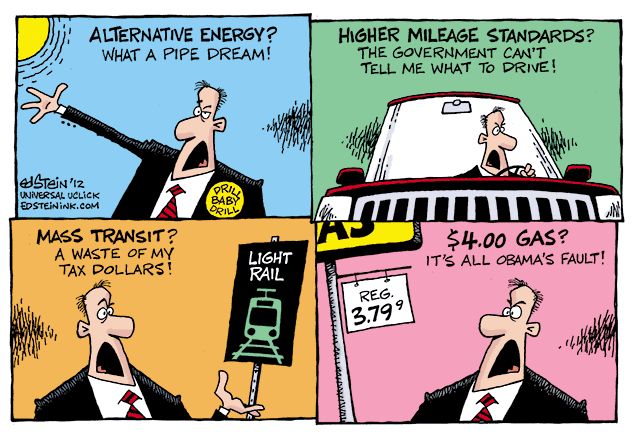
$4.00 Gas!?!!

I love this Ed Stein comic. Feels representative of the mindset of today's typical commuter. 

Tuesday, March 20, 2012

My First Exposure to Dystopia

From September 1981's episode of The White Mountains
As a Cub/Boy Scout, I was an avid reader of Boy's Life, the official magazine of the Boy Scouts of America. Being a kid, not many specifics of the magazine has stuck with me with the major exception of a cartoon that ran on the last page called The White Mountains. For years, I retained vague memories of this monthly picture into a a future world where alien tripods ruled over an enslaved earth, while a small band of boys struggled to stay free and find the rest of the freedom fighters.

Because the internet is awesome, I was able to find a complete collection of the comix strips at the Haunted Closet. Looking at them now, the comics don't have the same magic as they did back in the day - Frank Bolle's drawings are relatively pedestrian, and the pacing is breakneck in order to fit in enough information to keep you coming month to month. Still, to a young, impressionable kid, this was a first tasty exposure to a dystopia - and I liked it! It was a gateway drug into even more entertaining and disturbing scifi stories, while also fueling my love of graphical stories. It's nice to be able to see them again, and learn that the comics continued for years, covering all of John Christopher's Tripods Trilogy: The White MountainsThe City of Gold and Lead and The Pool of Fire. Enjoy!

Saturday, March 10, 2012

So Long Moebius


Moebius, the technically precise, surrealist French comix artist, has passed away. It's hard to find any of his books these days, but if you can - pick it up. You'll like it. Eulegy from Neil Gaiman here.

Update: Boing Boing points us towards a good documentary of the man.

Thursday, February 23, 2012

Do I Not Bleed?


One of the things that made the X-men comix great was the idea of these amazing heroes succeeding despite all of the odds against them (after all, in the great Marvel tradition, all of them were quite flawed), but also of being despised by society. In fact, in the classic Chris Claremont run (which I consider to be the definitive X-men - I know that i'm not telling you something you don't already know), the X-men were actively prosecuted for their being mutants, and thus not human. We're just like you, the X-men always argued, we just happen to have special powers (and kick-ass uniforms). It was powerful and moving and served as a great analogy for being a teenager - for after all, what teenager doesn't feel that they're uniquely different than everyone else, but still long to be accepted by their peers?

All of which makes Marvel's recent arguments in court all the more ironic. As usual, we follow the money, which pointed the folks at Radiolab to obscure tarrif regulations that state:
"Dolls," which represent human beings, are taxed at almost twice the rate of "toys," which represent something not human - such as robots, monsters, or demons.
So now Marvel is arguing that the X-men are really monsters, and not humans after all, all so they can save some money on their tax bill. Poor, poor X-men, rejected by their makers.

Boing Boing gives us the sad, rational denouement:
The solomonic court divided the mutants into varying degrees of humanness. In the human camp were the Invisible Woman, Punisher, Daredevil, U.S. Agent, Peter Parker, and Jumpsie were humans. The remainder (including the Fantastic Four) were mutants.
And no, I don't know who "U.S. Agent" or "Jumpsie" are either. Nor why the Invisible Woman is human while the rest of the Fantastic Four are mutants. Law is very strange in that way.

Saturday, February 11, 2012

The World of Ideas

Other than the mystifying 1969 version of The League of Extraordinary Gentlemen, I've been missing my Alan Moore fix. Did find an interesting interview with him in which, in response to the question "Is there a conflict between what can and can't be proven by science", he offers this tidbit:
I would prefer a two-state solution. My basic premise is that human beings are amphibious, in the etymological sense of 'two lives'. We have one life in the solid material world that is most perfectly measured by science. Science is the most exquisite tool that we've developed for measuring that hard, physical, material world. Then there is the world of ideas which is inside our head. I would say that both of these worlds are equally real - they're just real in different ways. The concept of a world of ideas, yes it's intangible, it can't be repeated in a laboratory, but pretty much the evidence for it is all around us. In that, every detail of our clothing, our mindsets, of the buildings and the streets and cities that surround us - that started life as an idea in someone's head.
His idea, borrowed from the kabbalah and the Tarot, of the Immeteria - a common world of the imagination - has been a lot of fun to ponder since I encountered it in his excellent series Promethia. I'd highly recommend that series, particularly up until Sophie travels through the godhead of existence. Yea, it's pretty deep stuff.

Thursday, October 6, 2011

Monsters!

My new favorite blog is Monster Brains. Lots of awesome artwork featuring monsters and aliens!

I love it if only for the fact that it reminded me of the awesome book and cover for John Christopher's The White Mountains., which I first experienced as a comic serial in Boys Life.

Wednesday, August 24, 2011

Sunday, August 21, 2011

Where are the Beefcake Comix

As much as I like comics, since I've gotten older and become more "mature," I've become more and more uncomfortable with the blatent sexism in most of the mainstream comix, mainly superhero fare from the big two of Marvel and DC. Now, I haven't seen the issue in question, but a recent issue of Justice League had Wonder Woman in a hypersexualized pose on the cover, and Alyssa Rosenberg points us to a series of pictures that shows how absurd it would be if all superheros were depicted in this manner. (Think Batman without pants.)

The great think about this article is Rosenberg's analysis: not content to point out sexism, she also makes the good point that there just aren't the opportunities to be sexist about men, to wit, these pictures "... don’t communicate to men what it’s like to see another man held up as an object of pure sexual desire for women’s consumption."

The whole article is good. Give it a read!

Tuesday, July 26, 2011

First Line of "A Wrinkle in Time"

"It was a dark and stormy night"
- Madeleine L'Engle, first paragraph of A Wrinkle in Time.

Kelly picked this one up this weekend, having somehow escaped her childhood without reading it. It's a fantastic little book, one that I credit a lot for firing up my pre-teen imagination.

Nowadays, tho, the first line kills me, because whenever I read of it I think of Snoopy. However, Wikipedia tells me that there's a bit more history to the line.